
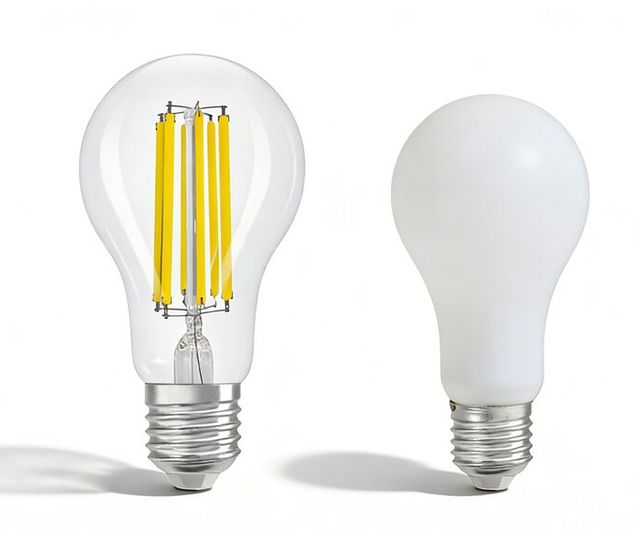
Choosing between LED lights vs. incandescent light bulbs isn't just a matter of preference, it directly impacts annual operating budget. If you are still managing properties equipped with traditional lighting, you are likely facing high energy bills and constant maintenance cycles.
However, LED technology offers ideal performance that optimizes lighting strategy, reduces overhead, and improves bottom line. This guide breaks down the critical difference between LED and incandescent light bulbs to help you make smarter lighting decisions.
LEDs are solid-state semiconductor devices that can directly convert electrical energy into light energy. Their main advantages are extremely low energy consumption and long lifespan. It significantly reduces the operating and maintenance costs of commercial lighting, such as in shopping malls, offices, and hotels. Together, these properties position LEDs as one of the most efficient light sources available today.
An incandescent lamp emits light by heating a thin tungsten filament to a white-hot state through an electric current. It is simple in structure, extremely low in cost, and can emit very warm and soft light, making the environment feel cozy. Although it is being gradually phased out due to its high power consumption and short lifespan, the classic warm light it brings is still loved by many people even today.
Lighting solutions directly impact a company's operating costs and energy efficiency. While comparing incandescent vs LED, it becomes clear that choice between legacy inefficiency and future-proof cost savings. Understanding the differences between LEDs and incandescent bulbs can help companies choose more energy-efficient and low-maintenance solutions.
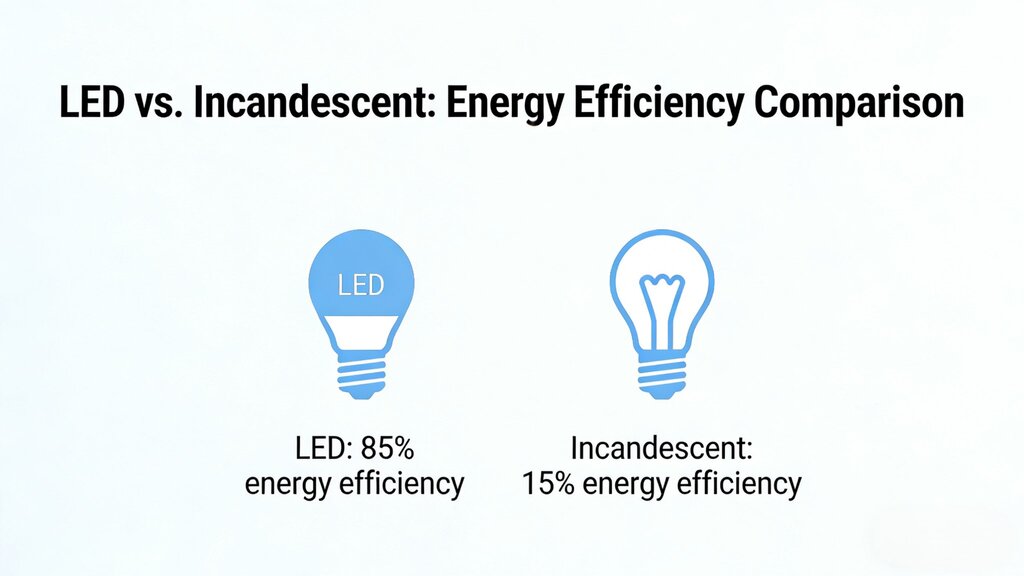
The difference in energy efficiency between LED and incandescent light bulbs is very significant. In simple terms, LED lights are much more efficient. Of the energy produced by incandescent lights, over 90% is lost in the form of heat, and less than 10% is converted into visible light. For instance, to deliver 800 lumens, an incandescent bulb requires 60 watts, whereas a LED achieves the same output using only 8 to 10 watts, which results in a 75% to 80% reduction in electricity costs.
LED lights are highly efficient, generate less heat, and often include effective thermal management designs. Therefore, they have an extremely long lifespan. It can typically reach 25,000 to 50,000 hours that significantly reduce maintenance frequency and redirect labor costs away from constant bulb replacements.
However, incandescent lights have a shorter lifespan due to the evaporation of the filament caused by high temperatures, usually only about 1,000 hours. This means that within its service life, one LED can replace 25 to 50 incandescent lamps.
In real-world applications, LED actual service life is often closer to the rated life when used under proper conditions, such as stable voltage and good heat dissipation. Instead, incandescent real lifespan is often even shorter than the rated life due to frequent switching, voltage fluctuations, and vibration.
When generating light of the same brightness, the heat produced by incandescent light bulbs is much greater than that of LED. This is because incandescent bulbs convert most of their energy into heat rather than visible light. This excess heat increases the cooling load on HVAC systems, especially in large indoor spaces, leading to higher energy consumption and operating costs. In contrast, LEDs generate far less heat, which helps reduce HVAC demand and overall cooling expenses.
While both types of lights provide a noticeable illumination the moment you press the switch, their underlying principles are fundamentally different.
Incandescent bulbs work by heating the filament, while LEDs emit light directly through the semiconductor. This is why LED lights are the more ideal choice for applications requiring frequent switching or instantaneous full brightness, such as warehouses, corridors, and motion-sensor lighting systems. It helps businesses and households save on energy and maintenance costs.
The color temperature of incandescent lights is a fixed and single warm yellow tone, while the color temperature of LEDs is very diverse. By changing the combination of internal chips and phosphors, LEDs can produce a wider range of color temperatures.
● Incandescent light bulb (2700K - 2900K): Ideal for homes, restaurants, and hospitality spaces.
● LED (2400K - 6500K): Neutral white (3500K–4100K) works well in offices, classrooms, and retail environments. Cool white to daylight (5000K–6500K) is commonly used in warehouses, hospitals, and task-oriented workspaces.
Incandescent bulbs offer excellent color rendering, but in commercial settings, high-CRI LEDs are usually the better choice. They deliver similar visual quality with much lower energy use and longer lifespan.
For general spaces, CRI 80 is enough. But high-CRI lighting is essential where product appearance drives sales:
● Food retail: makes produce look fresher and more appealing.
● Fashion stores: ensures accurate fabric colors, reducing returns.
● Premium retail: enhances detail and perceived value.
Compared to incandescent lighting, CRI 90+ LEDs provide strong visual impact with lower operating costs, helping businesses improve both presentation and efficiency.
The main price difference between LED lights and incandescent bulbs lies in their initial price and long-term operating costs. Generally, incandescent bulbs have a lower purchase price, while LED lights have a relatively higher unit price. However, in the long run, LED lights consume less energy and last much longer, which reduces electricity use and replacement frequency. When considering lifetime energy consumption plus maintenance costs, LEDs deliver a much lower total cost of ownership (TCO) than incandescent bulbs.
LED lights are more environmentally friendly than incandescent bulbs. LED lights are more energy efficient, consuming less electricity to produce the same brightness, thus reducing carbon emissions during power generation. They also have a longer lifespan, reducing the frequency of bulb replacements and waste generation.
Furthermore, LED lights typically do not contain harmful substances such as mercury, resulting in less environmental pollution during recycling. On the other hand, incandescent bulbs are less energy efficient, increasing energy consumption and indirectly contributing to greenhouse gas emissions, thus having a greater overall environmental impact.
They also have differences in fixture types. Incandescent lights are typically only available in a few bulbs and shapes such as A-type, candle bulbs, and reflectors.
LED lights, on the other hand, are much more diverse. They are available in traditional shapes like A-type, spotlight, and candle bulbs, as well as modern forms such as light strips, panels, downlights, and linear lights. Because LEDs are semiconductor light sources, they can be shaped and integrated in many ways to fit different uses.
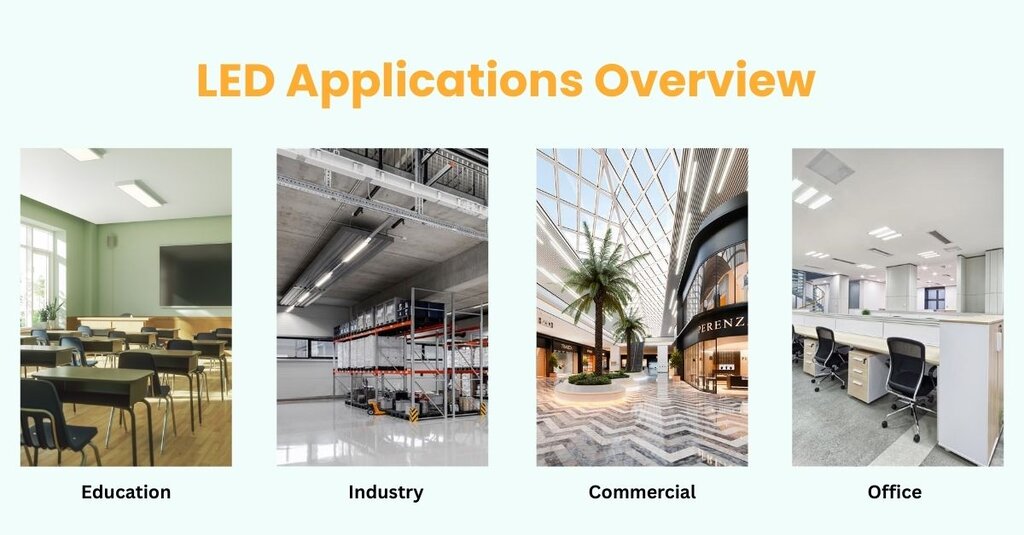
LED has become the mainstream choice for various lighting settings. Here is a list of LED commonly used in:
● Residential: Garages, outdoor gardens and patios, living rooms, bedrooms, bathrooms, kitchens.
● Commercial: Offices, meeting rooms, retail stores, supermarkets, shopping malls, restaurants, cafés, bars, hotels, lobbies, schools, hospitals, clinics, airports, museums, theatres, parking lots.
● Industrial: Factories, warehouses, cold storage, laboratories, power plants, logistics centers, mining sites, outdoor industrial yards.
Instead, the use of incandescent lights is more limited, but they still have their unique value. It is still often used in occasions that require a warm atmosphere or a retro aesthetic, such as:
● Home decor: Table lamps and decorative chandeliers
● Cultural spaces: Bookstores and art spaces
● Hospitality: Coffee shops, restaurants, bars, hotel lobbies.
For commercial and high-use spaces like offices, warehouses, retail stores, and corridors, LEDs are clearly superior due to multiple advantages. For home and hospitality settings where a warm, cozy, or retro atmosphere is desired, incandescent bulbs can still be preferred for their natural warm glow.
Besides being more energy-efficient, durable, and safe, the growth of LEDs has been driven by government policies, clear market, and business decisions.
As energy costs rise, companies and households are prioritizing economical lighting solutions to reduce operational budget, making LEDs a suitable choice. At the same time, market demand has shifted toward performance and flexibility, such as adjustable color temperature, higher CRI options, and smart control compatibility, all of which LEDs can provide.
In addition, regulatory trends are accelerating the transition, with stricter efficiency standards gradually phasing out inefficient incandescent products. Therefore, many enterprises have begun to reduce or stop the production of incandescent lights.
Therefore, LED has gradually replaced incandescent light bulbs and become the mainstream product in the lighting market.
Upgrade to energy-efficient lighting with LEDVANCE and experience a full range of high-quality LED lighting products, including high bay, strip, downlight, tubes, floodlight, panel etc. Whether in industrial plants, commercial offices, retail stores, or in homes, hotels, restaurants, and other environments, our products offer energy savings, lighting design support, and strong ROI. We comply with multiple international safety and environmental protection standards, such as RoHS, UL, CE, etc. Our team can help recommend the most suitable lighting solution based on your specific application and needs.
Generally, you can replace incandescent bulbs with LED, as most LED bulbs share the same shape and base, allowing them to fit standard sockets without modification. Just make sure the LED’s brightness matches the original bulb.
Incandescent bulbs are being phased out mainly due to their low efficiency. They waste most energy as heat and have a short lifespan, leading to higher operating and replacement costs. Additionally, the U.S. Department of Energy 2023 rule requires a minimum of 45 lm/W, which most traditional incandescent bulbs cannot meet.
FOLLOW US ON:


