

Many businesses and factories are upgrading from fluorescent to LED tube lights and face a critical question. Should they keep the ballast, bypass it, or switch to an external driver? Each option comes with trade-offs in cost, safety, and lifespan. Therefore, understanding different LED tube types leads to better purchasing decisions to save energy and reduce maintenance costs.
In this article, we will compare common LED tube types, including Type A, Type B, and Type C. They are classified based on how they are powered and installed, each with different requirements for ballasts, wiring, and drivers. This clear guidance helps you choose the most efficient and cost-effective solution for your project.
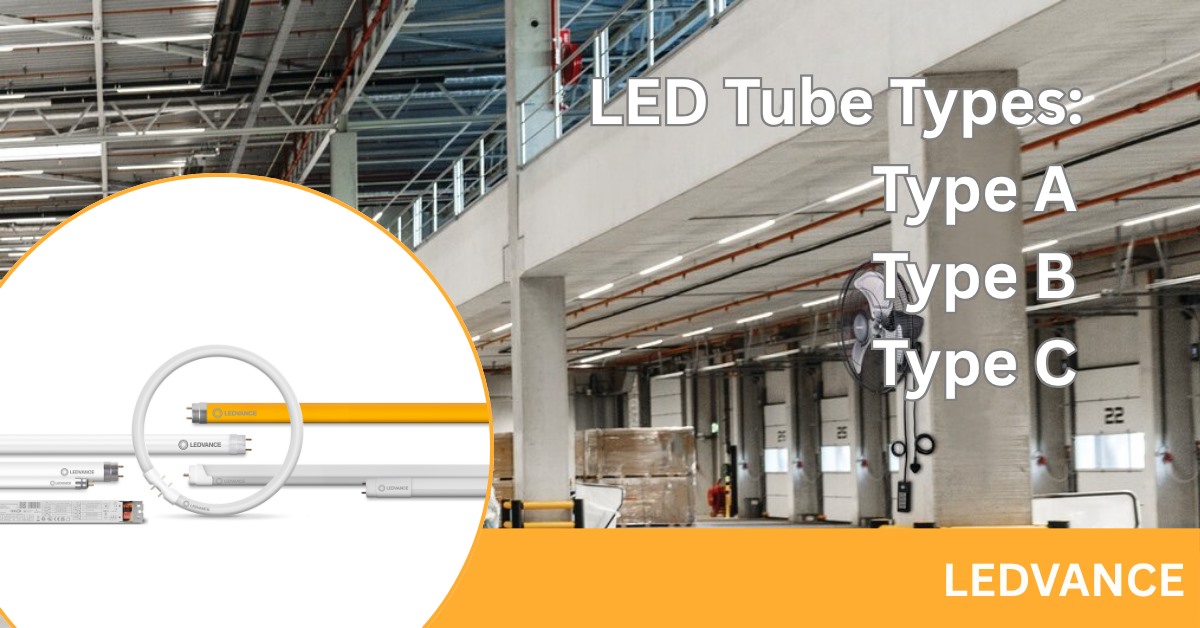
Type A LED tubes can be directly inserted into existing fluorescent lamp sockets and are compatible with original ballasts without the need to remove the ballasts or rewire them. Type A LED tubes offer a relatively simple installation with minimal disruption. Checking the manufacturer’s approved ballast list is required prior to installation.
It allows for quick replacement without major electrical rewiring, making it suitable for businesses, factories, and offices that want to upgrade from fluorescent lights to LEDs without downtime.
However, the old ballast remains in the circuit, which will continue to cause additional energy loss. Overall, the energy-saving effect and lifespan are not as good as other types of LED tubes that remove the ballast.
Pros:
Cons:
Typical Applications:
Type B, also known as ballast-bypass LED tubes, do not rely on the ballast of the original fluorescent lamp to work. Before installing Type B LED tubes to upgrade, it requires removal of the ballast and rewiring of the fixture.
Depending on the power supply configuration, Type B LED tubes are available in both single-ended and double-ended designs. Single-ended tubes are powered from one end, where both line and neutral are connected on the same side. Double-ended tubes are powered from both ends, with line and neutral connected at opposite ends of the tube.
After removing the ballast, clear labels are indispensable to prevent the accidental installation of incompatible lamps. It may cause LED tube failure or safety hazards (electric shock/fire risk).
Pros:
Cons:
Typical Applications:


FOLLOW US ON:


