
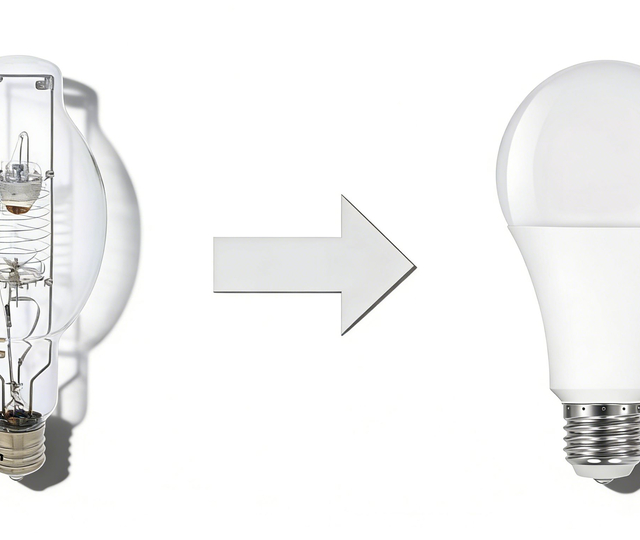
Metal halide LED replacement is one of the most effective ways to upgrade lighting solutions in industrial and outdoor applications. As the metal halide market in the United States is shrinking rapidly, using LEDs is the main choice to help energy efficiency, stable lighting, and cost savings.
In this guide, we’ll explore how to replace metal halide with LED, including equivalent wattages, how to determine the right lumen output, retrofit vs. full fixture replacement, and expected cost savings & ROI, helping you make a confident upgrade decision.
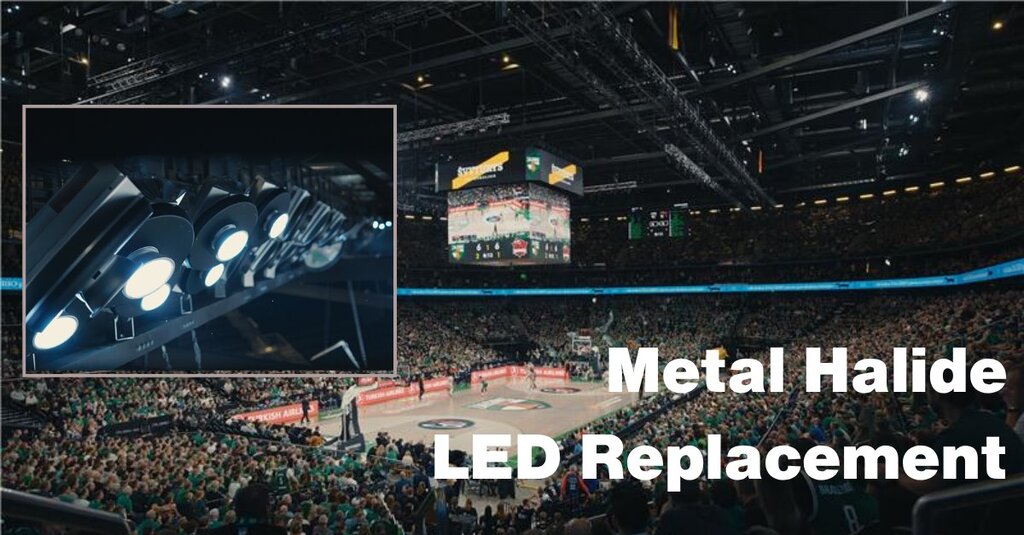
Metal halide to LED replacement is an upgrade solution that many factories and commercial places are currently undertaking. The shift is driven by the significant performance, efficiency, and maintenance advantages LEDs offer.
LEDs can deliver the same or higher light output with less energy. This means that long-term use can significantly reduce lighting energy consumption by 60-80% to save electricity costs. Metal halides have relatively low energy efficiency. They require high power to light up and their light output fades rapidly.
LEDs last 3 to 5 times longer than metal halide lamps. It reduces maintenance frequency, labor costs, and downtime. In practical applications, metal halides often encounter problems such as slow startup, unstable bulb lifespan, and yellowing or color deviation after a period of use.
LEDs reach full brightness instantly with no warm-up time. This makes LEDs more suitable for environments that require stable lighting, such as warehouses, sports venues, and parking lots. In contrast, metal halides require preheating time and it may take several minutes for the lamp to fully light up. If there is a sudden power outage and then a restart, it will take even longer.
LED offers uniform and flicker-free lights. Metal halides often flicker at the end of their lifespan and emit ultraviolet rays and a large amount of heat. This wastes electricity, adds to HVAC loads in indoor facilities, and burdens both equipment and the environment.
LEDs do not contain mercury and do not require special recycling treatment. However, metal halides contain mercury and other chemical substances inside that need to be strictly recycled; otherwise, they may cause pollution. Nowadays, many businesses and industries are taking the green and energy-saving route and adapting evolving lighting regulations. LEDs can also help them achieve environmental protection goals.
Although LED lighting may have a higher upfront cost, its lower energy consumption, reduced maintenance requirements, and longer lifespan result in a lower total cost of ownership. For both commercial and industrial applications, upgrading to LEDs is a financially smart and economically meaningful investment.
| Feature | LED | Metal Halide |
|---|---|---|
| Energy Efficiency | High (Converts 80% energy to light) | Moderate (Loses much energy to heat) |
| Lifespan | 50,000+ hrs | 6,000–15,000 hrs |
| Light Depreciation | Slow (Stays bright until end of life) | Rapid (Loses about 50% brightness by mid-life) |
| Controls | Instant on/off; Easy dimming | Long warm-up/restrike time |
| Maintenance | Minimal | High (Frequent bulb and ballast changes) |
| Environmental | Eco-friendly (No mercury) | Contains mercury; Requires special disposal |
| Heat Generation | Mercury-free and recyclable | High; Can increase HVAC costs |
To start, understanding lumens is essential when upgrading from metal halide to LED lighting. Lumens measure the total light output of a fixture and reflect its perceived brightness, making them a more accurate indicator than wattage when choosing LED lights.
Metal halide and LEDs have completely different luminous efficiencies; LED lights can produce more light while consuming less energy. Replacing only the wattage when upgrading lighting can result in excessive or insufficient brightness, a poor visibility, or unnecessary energy consumption. For accurate brightness matching of the two types of lamps, here is a lumen conversion chart to help you avoid incorrect selection and rework.
| Metal Halide Wattage | Metal Halide Lumens | Recommended LED Wattage | Recommended LED Lumens |
|---|---|---|---|
| 100W | 8,000–9,000 lm | 25–40W | 3,500–5,500 lm |
| 175W | 14,000–16,000 lm | 45–60W | 6,000–9,000 lm |
| 250W | 20,000–24,000 lm | 80–100W | 11,000–15,000 lm |
| 320W | 28,000–32,000 lm | 100–120W | 14,000–18,000 lm |
| 400W | 36,000–40,000 lm | 120–150W | 18,000–22,000 lm |
| 450W | 42,000–46,000 lm | 150–180W | 22,000–26,000 lm |
| 750W | 70,000–80,000 lm | 240–300W | 35,000–45,000 lm |
| 1000W | 100,000–110,000 lm | 300–450W | 45,000–60,000 lm |
| 1200W | 120,000–135,000 lm | 450–600W | 65,000–85,000 lm |
| 1500W | 150,000–165,000 lm | 600–800W | 85,000–110,000 lm |
In particular, 400W metal halides are a very common wattage for industrial, warehouse, stadiums, parking lots, and high-mast lighting. When new, a 400W metal halide can produce around 32,000 lumens, but due to rapid lumen depreciation, output can drop significantly. By contrast, when replacing a 400W metal halide, a 120W to 150W LED is generally sufficient to achieve the same lumen, or even greater. It produces about 18,000 to 22,000 lumens.
This may sound like a significant difference, but it's because LEDs have higher luminous efficiency, strong directionality, and produce virtually no ineffective scattered light. Metal halide wastes a lot of light, such as being absorbed by the casing or incompletely reflected by reflectors. LEDs, on the other hand, emit light in a specific direction, delivering accurate light distribution in Type III, IV, and V patterns.
There are two main ways to upgrade metal halide lighting to LED. To make the right choice, we need to understand the differences between the two and the benefits they each bring.
Full LED fixtures replacement is removing the whole metal halide fixtures and replacing them with entirely new LED luminaires. It is a complete replacement rather than a partial upgrade, providing the most comprehensive performance improvement.
The optical structure, power driver, heat dissipation system, and LED light source of the new luminaire are all specially designed. As a result, they offer uniform brightness distribution, lower energy consumption, longer lifespan, and greater system reliability.
In addition, new luminaires often support intelligent control. For many applications looking to improve lighting quality, such as high ceiling lights, streetlights, or stadium lights, a brand-new LED fixture can provide the ideal lighting experience and long-term ROI.
LED retrofit kit is a way to replace the internal light source of old lamps with LEDs, which retains the original metal halide casing. Therefore, the installation is fast and the labor cost is low. There is no need to worry about damaging the building structure.
Also, the retrofit process involves almost no downtime, allowing businesses to continue normal operations. Some modification kits also support different brightness options, making it easy to adjust the lighting according to the needs of the scene.
If you don't want to spend too much money or remove your existing lighting fixtures, then an LED retrofit kit is an economical and simple option.
First, let's set a current metal halide system and count on annual cost.
● Existing setup: 50 × 400W metal halide fixtures
● Operating time: 12 hours/day, 300 days/year
● Electricity cost: $0.12/kWh
● Metal halide system actual power (with ballast): 455W per fixture
Annual electricity cost: 50 fixtures × 455W × 12 × 300 × $0.12 = $9,828/year
Total annual cost (Metal Halide): Annual electricity cost + $4, 000 Maintenance cost (lamp + labor) ≈ $13,800
For LED Retrofit Kit:
● Retrofit kit power: 150W
● Retrofit kit cost: $120 per fixture
● Installation cost: $30 per fixture
Initial investment: 50 × ($120 + $30) = $7,500
Energy consumption: 50 × 150W = 7.5 kW
Annual energy use: 7.5 × 12 × 300 = 27,000 kWh
Electricity cost: 27,000 × $0.12 = $3,240/year
Maintenance cost: ~$20 per fixture per year = $1,000/year
Total annual cost (Retrofit): ≈ $4,240
Savings vs Metal Halide: $13,800 – $4,240 = $9,560/year
Payback period: $7,500 ÷ $9,560 ≈ 0.8 years
For Full LED Fixture Replacement:
New LED fixture power: 150W
● Fixture cost: $220 per unit
● Installation cost: $50 per fixture
Initial investment: 50 × ($220 + $50) = $13,500
Energy consumption: Same as retrofit → $3,240/year
Maintenance cost: ~$500/year
Total annual cost (Full LED): ≈ $3,740
Savings vs Metal Halide: $13,800 – $3,740 = $10,060/year
Payback period: $13,500 ÷ $10,060 ≈ 1.3 years
The best choice ultimately depends on your needs. The important thing is to make your choice based on the site conditions, budget, and lighting objectives.
Upgrading from metal halide to LED is more than a one-by-one change. There are several factors to consider when you choose proper fixtures.
Always match lumens instead of wattage. Ensure lumen is aligned with original brightness and check the amount of light delivered to the target area, not just the raw lumen on the label.
Alternatively, you can choose higher-brightness LED fixtures to reduce the number of fixtures required, thereby lowering the overall project cost. In high-ceiling or large-area lighting scenarios, using LEDs with higher lumen output can expand the coverage of a single lamp, reduce installation points and construction costs, and also help reduce later maintenance costs.
For example, while replacing 20 400W metal halide with 150W LEDs is the standard approach, a higher-output strategy often yields better returns. By utilizing 240W LEDs instead, you can reduce the total fixture count to just 12–14 units. Despite a higher cost per lamp, this reduction in hardware lowers procurement, installation, and long-term maintenance expenses by approximately 15%–25%.
Mounting height directly affects lumen requirement and light distribution.
● Low ceilings (<15 feet): Focus on wider diffusion to minimize glare.
● High ceilings (20 feet): Require higher lumen output and denser optics to deliver sufficient light to the work surface.
Unlike metal halide bulbs that emit light in 360 degrees, LEDs are directional.
Narrow angle (60°-90°): Best suited for high ceilings or corridors in warehouses.
Wide angle (120°+): Best suited for general area lighting and lower installation heights to ensure uniform coverage without dark spots.
Metal halides offer a high color rendering index, and many LEDs can achieve similar results. For most industrial and warehouse applications, a CRI of 70–80 is sufficient, while areas like retail, quality inspection, or food processing benefit from CRI 90+ for more natural colors.
Not all LEDs work with existing dimmers. Because older dimmer systems were often designed for metal halide, they may not function properly with LED drivers. Before installation, confirm that the LED driver and the existing control system are compatible.
In the U.S., metal halide lamps have not been completely banned all at once, but they are affected by a combination of regulatory and market‑driven forces. Since 2007, the Department of Energy (DOE) has required metal halide lamps to comply with energy efficiency standards. All lamps on the market must pass the DOE's testing procedures and minimum energy efficiency standard in order to remain legally available in the market.
On February 13, 2026, the DOE issued two separate final determinations, concluding that existing energy efficiency standards for metal halide lamp fixtures and small electric motors will remain unchanged because more stringent standards were not found to be cost‑effective. This means federal energy efficiency requirements for metal halide lamps will stay as they are rather than being tightened.
Meanwhile, the United States is accelerating the phasing out of mercury-containing lamps, and metal halides fall into this category. According to the lighting regulations update released in 2026, several states have already implemented or are about to implement Clean Lighting Acts.
If you are considering replacing your metal halide with LEDs, then choosing the right supplier is critical for achieving long-term performance and reducing upgrade budget. Whether you're replacing whole fixtures, or want to retain the original housing with a retrofit kit, LEDVANCE provides solutions for industrial and commercial applications. For instance, we have completed upgrade lighting projects for Concordia university sports field and Bellingham international airport parking area. By replacing outdated metal halide fixtures, it cut energy use by 56%, saving the airport 100,000 kWh and over $10,000 in annual operating costs. With a 150,000‑hour lifespan, the new system reduced maintenance expenses by $6,000–$8,000 per year. The project earned nearly $27,000 in rebates and reached payback in just 1.1 years.
Also, LEDVANCE offers a variety of installation options and fixture types to suit different applications. In our metal halide replacement product page, you can explore all LED alternatives, including high bay, area light, retrofit kits, and replacement bulbs. You can more intuitively compare different LED replacement solutions and quickly find the best lighting model for your project. Contact us now to get a customized MH-to-LED replacement plan and product recommendations for your lighting upgrade.
Yes, it’s possible, but not always a direct swap. Most LED replacements require removing or bypassing the existing ballast. For best results, check your fixture type first and choose a compatible LED solution for safe, stable operation.
When replacing metal halide with LED, whether you need to remove or bypass the existing ballast depends on the LED type:
Type A (ballast compatible): Can operate directly with the existing ballast. No ballast removal is needed, but always follow the manufacturer’s instructions to ensure compatibility and safety.
Type B (ballast bypass): Require a direct connection to line voltage, so the existing ballast must be removed or bypassed during installation.
Type C (external driver): Use a separate driver unit instead of the fixture’s ballast. The ballast is typically not used, and wiring must follow the driver’s specifications.
LED upgrades typically cut energy use by 50–70% and reduce maintenance costs by up to 50%. Most projects see a payback period of 1–2 years, with continued savings throughout the system’s life.
FOLLOW US ON:


